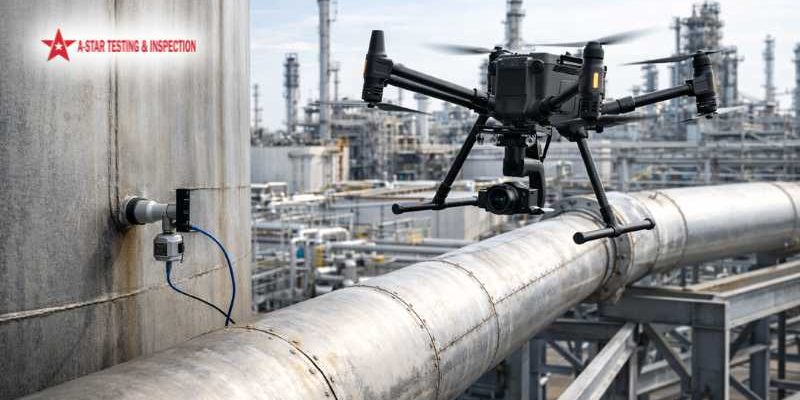
Drones Inspection (UTM & Close Visual) is changing the way companies handle their important assets in the fast-paced maintenance sector in the industry. Conventional techniques can be costly with regard to scaffolding, hazardous rope work, or total facility closure. In comparison, the current UAV technology allows safe, fast, non-invasive inspection that can reach the highest stacks of flares and the most complicated topside modules.
With the integration of drone ultrasonic thickness measurement (UTM) and close visual inspection conducted with a high level of resolution, organizations can obtain data about the condition of the elements within millimeters, which is accurate, and minimize the impact of operational risks and downtime to a minimum. As of today, these industrial drone inspection services have become the standard for oil and gas, power plants, petrochemical facilities, and offshore topside structures.
What Is Drone Inspection (UTM & Close Visual)?
The drone inspection services are carried out by using specialized unmanned aerial vehicles (UAVs) that have sophisticated sensors to be able to carry out remote inspection of the industrial assets. This two-fold technique offers a comprehensive perspective of the health of an asset:
- Drone UTM Inspection: In this case, the drone will touch a surface, and a special probe will measure the remaining thickness of the wall. It is a critical component of drone inspection programs for non-destructive testing.
- Drone Close Visual Inspection (CVI): In this one, ultra-high-definition (UHD) cameras and thermal sensors will be involved to gather data on the surface and detect defects that could not be seen by people on the ground.
These approaches, combined, create a unified asset integrity drone inspection plan that meets the internal safety regulations as well as international ones.
Drone Ultrasonic Thickness Measurement (UTM)
Drone ultrasonic thickness measurement enables the inspectors to measure the elevation corrosion and wall thinning at high or inaccessible places without necessarily using physical manual access.
Precision Applications:
- Storage Tank Shell & Roof Inspection: A quick mapping of the integrity of big-diameter tanks.
- Flare Stack/Chimney Inspection: The thickness is measured on live or hot objects where access cannot be made by man.
- Offshore Topside Inspection: The structural health of FPSOs and platforms.
- Pipeline Drone inspection: Scan of erosion on the high pipe racks.
Technical Benefits:
- Proper Corrosion Mapping: Finding out the so-called thin spots in advance before they cause leaks.
- No Scaffolding Needed: Saving hundreds of man-hours and thousands saved in mobilization expenses.
- High-Resolution Data: Digital records, which can be compared based on years to trace the rates of decay.
Drone Close Visual Inspection (CVI) Services
UTM provides information about what is happening in the metal, but instead, drone close visual inspection is used to find out what is happening on the surface. Nowadays, CVI drones have high optical zoom lenses that deliver a bolt-level view of industrial assets.
Common CVI Applications:
- Weld Inspection and Structural Steel: Cracks, deformation, coating failures.
- Constrained Space Drone Inspection: This involves using caged drones to perform an inspection in the interior of tanks and boilers in a safe way.
- Surveys of wind turbines and power plants: Checking blades, cooling towers, and boiler walls.
- Marine Topside Assets: Keeping a track of the consequences of salt-spray corrosion on offshore construction.
This will give visual data in real time, thus enabling engineers to make instant decisions when there is a turnaround or shutdown.
Why Drones are the Preferred Rope Access Alternative
For decades, the only method used to inspect high-elevation assets had been rope access. Drones-based inspection solutions are today considered to be a better alternative to the rope access inspection technique due to several reasons:
- Unrivaled Safety: It practically excludes the Work at Height hazard. With drone failure, there is lost equipment; with human failure, the price is life.
- Deep Cost-Efficiency: UAVs require only a few minutes to deploy, and scaffolding may require weeks to put up and take down.
- Less Intensive: UAV inspection of many facilities can be done when a plant is running without the massive expenses required to shut down an operation.
- Digital Asset Management: Each flight generates a digital twin or a high-resolution map, which is directly connected to your asset management software.
Standards, Certification, and Compliance
To make sure that the obtained data is valid when it comes to insurance and regulatory audit, the professional drone inspection services should be provided within rigid frames:
- Aerodrones Inspected by ISO Certified Drone: Quality management at all levels.
- Certified NDT Personnel: Pilots should be accompanied by ASNT-certified or PCN-certified NDT technicians in the interpretation of the UTM data.
- Aviation Authority Approvals: This implies that, in Malaysia, there is a strong compliance with CAAM (Civil Aviation Authority of Malaysia) industrial airspace requirements.
FAQs: Drone Inspection (UTM & Close Visual)
Q1: To what extent is Drone UTM inspection accurate?
Ans: It is highly accurate. The current sensors can give a precision of readings as close as 0.1mm/-0.1mm, as hand-held ultrasonic gauges have.
Q2: Can the drones check the interior of a storage tank?
Ans: Yes. We do confined space drone inspections by using specially constructed collision-resistant drones (e.g., the Elios 3) within tanks, pressure vessels, and boilers.
Q3: Can drone inspection be safe in the case of live refineries?
Ans: Absolutely. Specialized drones are equipped with EMI shielding to be able to work safely around flare stacks and other sensitive industrial electronics.
Q4: What type of reports shall I get?
Ans: You are provided with a detailed digital inspection report with geo-tagged high-res pictures, 4K video records, and a localized map of all UTM thickness measurements.
Conclusion: The Future of Asset Integrity
Drone Inspection (UTM & Close Visual) does not exist as a futuristic feature anymore, a modern industrial requirement. Industries would be able to reduce their safety profile dramatically and reduce maintenance expenses by combining drone ultrasonic thickness measurement with high-definition visual surveys.
In a business where the duration your assets are down means lost money, the UAV technology will offer the speed and accuracy you need to ensure your facility is safe and effective.
Call A-Star Testing & Inspection to implement the latest drone inspection services to meet your asset integrity requirements.